You can be the most gifted practitioner in your city and still be its best-kept secret. Visibility isn't posting more. It's choosing where the right clients are most likely to discover you, and building a clear path from there to your door.
You'll walk away with a focused visibility plan built around your one best channel, and a first step you can finish in under an hour.
The distinction
Visibility is not marketing
Most practitioners hear "visibility" and think "I need to post more on Instagram." That's like hearing "eat well" and thinking "I need more kale."
Social media might be part of it. Marketing might be part of it. But neither one is the thing itself. Here's the difference:
Marketing
What you say
Your message, your offer, your words. It answers "why should someone choose me?"
Social media
One place to say it
A single channel, with its own rules, rented from a platform that can change them anytime.
Visibility
Whether they ever find you
The path between your work and the right person, in a place they already trust, at the moment they're ready.
A beautiful message nobody sees helps no one. A practitioner posting every day to an audience of other practitioners is busy, but not visible. Visibility asks a sharper question: when my ideal client is ready for help, where are they, and will I be there?
Visibility isn't fame, either. You don't need to be seen by everyone. If you see fifteen or twenty clients a week, you don't need a following. You need to be findable, memorable, and recommended inside a small, specific world.
If you've done the work of getting clear on who your ideal client is, this is the next question. You know who they are. Now: where do they go looking, and who do they ask?
Borrowed from the tech world
The best product doesn't win. The best-distributed one does.
In Silicon Valley there's a saying: first-time founders obsess over the product, and second-time founders obsess over distribution. The second-timers learned the hard way. Brilliant apps die every day, not because they're bad, but because nobody ever found them.
Poor distribution, not a poor product, is the most common reason businesses fail.A paraphrase of Peter Thiel, Zero to One
Your healing work is the product. Most practitioners we meet are exceptional at the product and have never been taught a thing about distribution. That isn't a flaw in you. It's a gap in every training program, from Ayurveda school to massage certification. Here's what the tech world figured out that applies directly to you:
01
One channel usually does most of the work
Startups that grow almost always have a single dominant channel. Not five. One. The rest are supporting players.
For a practitioner, that might be referrals from one chiropractor, a monthly workshop at one studio, or Google search in your neighborhood. Find yours and pour into it.
02
Test wide, then focus narrow
The book Traction describes a "bullseye" approach: brainstorm every possible channel, run small tests on a few, then go all in on the one that works.
Most practitioners do the opposite. They half-commit to everything and never learn what actually works.
03
Channel fit matters as much as product fit
A channel has to fit three things at once:
Your client: are they there, and open?Your offer: does it build enough trust?You: can you sustain it with joy?
A $2,000 program needs a channel where deep trust can form. A $95 massage can be found on a map.
04
Owned, rented, and borrowed
Tech companies know the difference between audiences they own and audiences they rent.
Borrowed audiences are a practitioner's secret weapon: a studio's community, a podcast's listeners, a doctor's patients. Borrow trust, then invite people somewhere you own.
05
Some channels compound. Some don't.
Ads and events stop the day you stop. A blog post, a Google review, a YouTube video, or a referral partner keeps sending people for years.
You need both: something that brings clients now, and something that builds while you sleep.
06
Every channel ends in a search
Someone hears your name at a dinner party, in a podcast, from their acupuncturist. What do they do next? They Google you.
If nothing clear shows up, the recommendation dies right there. Being findable is the floor every other channel stands on.
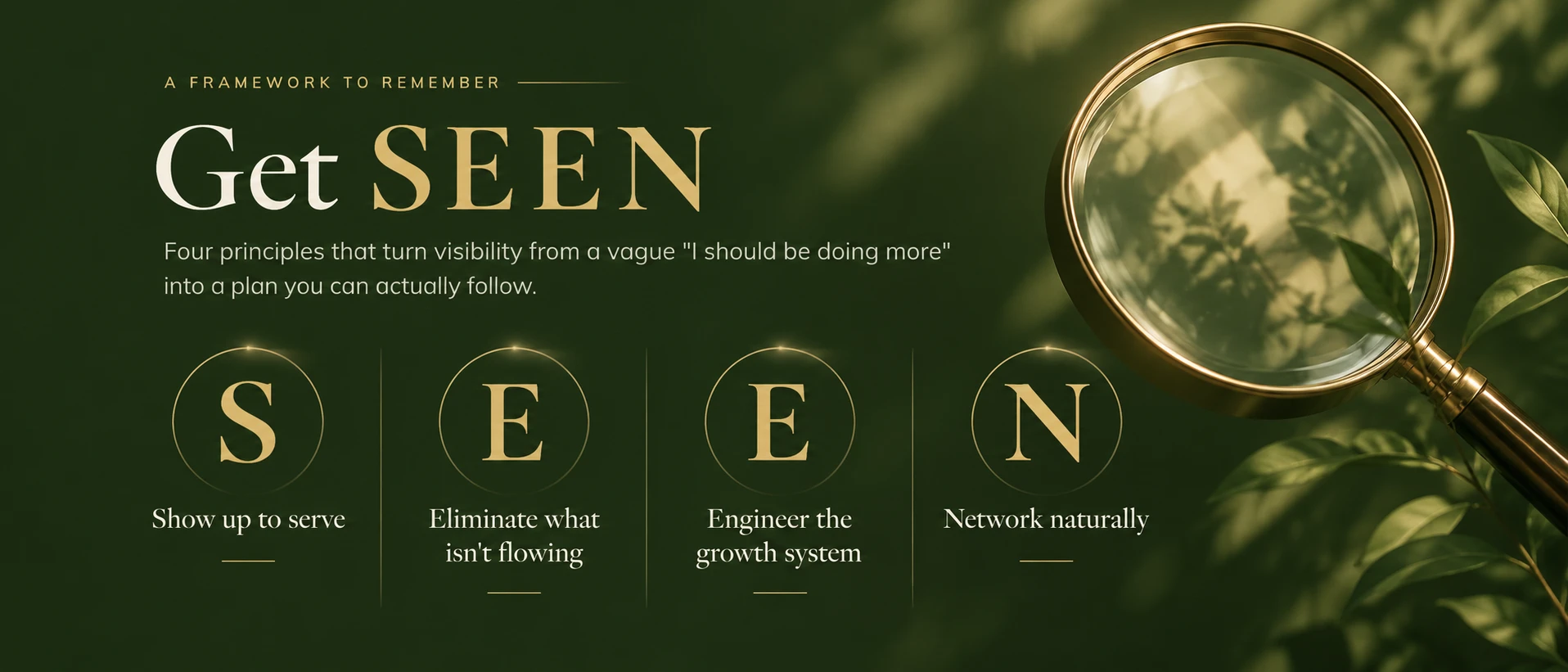
Get SEEN: Show up to serve, Eliminate what isn't flowing, Engineer the growth system, Network naturally
S
Principle one
Show up to serve
Consistency beats intensity, every time. And how you show up matters as much as how often.
Visibility is built on repetition. People rarely book the first time they see you. They book after the third workshop, the tenth helpful post, the second friend who mentions your name. Every time you disappear for two months, the count starts over.
So the first question isn't "how much can I do?" It's "what can I keep doing on my worst week?" That's your floor. One post a week you never miss beats a burst of daily posts followed by silence. One workshop a month at the same studio beats five scattered events.
Come as a giver, not a taker
People can feel the energy behind what you share. When you show up to get clients, people feel pursued. When you show up to help, people feel cared for, and they lean in. Before you post, speak, or reach out, ask: how can I add value to the person on the other side of this?
Taking energy"Only 3 spots left in my program! Book your consult today."
Giving energy"3 signs your afternoon crash is a blood sugar issue, not a caffeine issue, and what to eat at 2pm instead."
Taking energyJoining a networking group and handing everyone a business card.
Giving energyJoining the group and asking each person who their ideal client is, so you can send them referrals.
Generosity isn't the opposite of a business strategy. It is the strategy. Give away your best thinking freely. People don't hire you for information. They hire you for transformation, accountability, and you.
Try this: write down your minimum viable consistency, the smallest commitment you'd keep even in a hard month. That number, not your ambitious one, is the foundation of your plan.
E
Principle two
Eliminate what isn't flowing
Think of every place you show up as a channel of energy. When it's healthy, energy moves in three directions.
To you
People respond, ask questions, sign up, book, or refer. Something comes back.
Through you
It feels natural. You lose track of time in a good way. You'd do some of it anyway.
From you
You can give generously here without feeling drained, resentful, or fake.
If a channel isn't flowing in these directions, it's a blockage, and blockages cost you. The Instagram account you dread, the networking breakfast where nobody is your client, the Facebook group full of other practitioners pitching each other: each one takes energy you could pour into a channel that's actually moving.
Give yourself permission to quit. You do not need to be everywhere. An abandoned account with a post from two years ago can quietly suggest an abandoned practice. Better to be fully present in one place than half-present in six.
"Not flowing" versus "not yet"
One important distinction: a channel that hasn't worked after three weeks usually isn't broken. It's young. Give a new channel about 90 days of steady effort at your sustainable pace, and watch one signal: inquiries, sign-ups, replies, or referrals. Still nothing, and it drains you? Eliminate it with a clear conscience.
Channels to consider
Here's a wide view of where practitioners find clients. You only need one or two of these to flow.
In person
Workshops at yoga studios, gyms, and libraries. Wellness fairs, farmers markets, meetup groups, coworking spaces, community centers, corporate lunch-and-learns.
Referral partners
Chiropractors, therapists, acupuncturists, doulas, dietitians, personal trainers, functional medicine doctors, studio owners, and past clients.
Online communities
Facebook groups, Reddit, Circle and Skool communities, local parent groups, Slack and Discord groups, alumni networks.
Content
Instagram, TikTok, YouTube, Pinterest, LinkedIn, a Substack newsletter, a blog, guesting on podcasts or hosting your own.
Search
Google Business Profile, your website, practitioner directories, professional association listings, review sites.
E
Principle three
Engineer the growth system
Showing up creates attention. A system turns attention into relationships, and relationships into clients, without you chasing anyone.
Here's where most visibility effort leaks away. You give a wonderful talk. The room loves it. Everyone leaves inspired, and you never hear from any of them again. The talk wasn't the problem. There was simply no next step.
Every visibility activity should lead somewhere. Think of it as a path:
Discover→Capture→Nurture→Book→Refer
The pieces that make the path work:
Search and SEO
A complete Google Business Profile, a website that names who you help and where, and pages that answer the questions your clients actually type.
Lead magnets
A free, genuinely useful resource offered in exchange for an email: a guide, a short video series, a quiz, a seasonal routine. (You may be reading one right now.)
Speaking opportunities
Talks, workshops, and podcast interviews put you in front of a borrowed audience that already trusts the host.
Contact info and follow-up
Your booking link, email, and phone number in every bio, slide, and signature. And a follow-up within 24 hours of every meeting or event.
Social media, organic and paid
Organic posts build trust over time. Small, targeted ads can put your lead magnet in front of the right people in your area faster.
Email
The audience you own. A short, regular note keeps you present for the months it takes someone to be ready.
What it looks like together
A massage therapist gives a free 20-minute talk on desk posture at a local coworking space. Discover. At the end, a QR code offers a free "5-Minute Desk Reset" video series. Capture. Three short emails over ten days share stretches and a client story. Nurture. The last one offers a first-visit special for coworking members. Book. After a great session, she hands each new client two guest passes for a coworker. Refer.
Same talk. Completely different result.
Try this: add "How did you hear about me?" to your intake form today. It takes five minutes and it's the single most useful piece of visibility data you'll ever collect. Within a few months, it tells you exactly which channel is flowing.
N
Principle four
Network naturally
Be the person who knows people. When you connect others generously, you end up in the middle, right where value flows.
Forget the stiff, transactional version of networking. Natural networking is simply this: keep asking yourself who do I know that this person should meet? Then make the introduction, without keeping score.
Think about it like a hub. When someone in your community asks, "Do you know a good therapist? A doula? Someone who does websites?", you're the one with an answer. People remember who helped them. Over time, the introductions you make come back as referrals, collaborations, speaking invitations, and trust you could never buy.
Client to practitionerA client mentions anxiety that's beyond your scope. You introduce them to a therapist you trust, and the therapist now knows exactly what you do.
Practitioner to practitionerYou connect a yoga teacher who wants to run a retreat with a nutritionist who wants to teach one. They co-host, and both mention you.
Community to communityYou tell a studio owner about a coworking space looking for wellness programming. You're the natural first speaker.
Sharing generouslyYou share another practitioner's workshop with your email list. Generosity is noticed, and usually returned.
Make it easy and respectful
Use the double opt-in intro: ask each person privately if they'd like the connection before you make it. Then write one short message to both, saying why you think they should meet. It protects everyone's time and makes you look thoughtful, not pushy.
Keep a simple list of 15 to 20 people you trust and refer to: practitioners, studio owners, local business people. Know who each one serves best. That list is quietly one of the most valuable assets in your practice.
Try this: make two introductions a month. That's it. Within a year you'll have made two dozen connections, and become someone people think of first.
Before you start
Four things that save months
One channel, plus a floor
Pick one primary growth channel. Underneath it, make sure you have a findability floor: a Google Business Profile or simple website with a clear booking link. That's the whole plan for the next 90 days.
Start where it's already working
Look at where your best clients came from. If three of them were referred by the same person, that's not luck. That's a channel asking to be built on.
Quiet people can be very visible
Visibility doesn't require being loud. Writing, search, one-on-one coffees, and referral partnerships are some of the strongest channels there are, and none of them need a camera.
Hiding isn't humble
If being visible feels like bragging, try this reframe: if your work genuinely helps people, being hard to find is a disservice to the ones who need you right now.
The exercise · About 5 minutes
Find your best channel
Answer five quick questions. You'll get the channel most likely to bring you the right clients, why it fits, a SEEN plan for it, and a first sprint you can finish in under an hour.
Questions
Frequently asked
What's the difference between visibility and marketing?
Marketing is what you say. Social media is one place you might say it. Visibility is whether the right person actually encounters you, in a place they already trust, at the moment they're ready for help. It's the path between your work and the people who need it.
How many channels should I focus on?
One primary growth channel, plus a findability floor: a Google Business Profile or simple website where anyone who hears your name can find you and book. Most practices grow from one channel that works, not five that half work.
How long should I try a channel before giving up?
About 90 days of steady effort at a pace you can sustain. Track one signal, like inquiries, sign-ups, or referrals. Not flowing after a fair trial means eliminate. Not flowing after three weeks usually means not yet.
Do I have to be on social media?
No. Many thriving practices grow mostly through referral partners, workshops, Google search, and past clients. Choose social media only if your ideal clients are there and it gives you energy.
What if I'm brand new and don't have past clients?
Start with borrowed trust: referral partners, workshops at spaces your ideal clients already visit, and helpful answers in communities where they ask questions. These let you borrow someone else's credibility while you build your own.
Can you help me build the system?
Yes. Veda Build designs the websites, Google profiles, lead magnets, booking flows, and follow-up emails that turn visibility into booked clients. Request a free quote.
Your next step
Pick one channel. Show up for 90 days.
You don't need to be everywhere. You need to be fully present in the one place your right clients are already looking, and easy to find when they go searching.